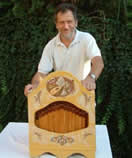
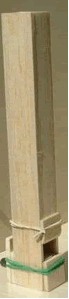
In average a pipe is obtained by assembling some fifteen pieces which must be individually built with balsa wood, carton and hard wood and then glued together with an infinite patience, for an overall total of about 300 little pieces.
The pipes are of the closed type and tuning is achieved by sliding in its interior a stopper. This is a little piston realized with a rectangular piece oh balsa covered with a piece of leather to assure that air do not flow, placed in the upper part of the pipe.
This operation is not critical and gives immediately a good result.
Pipe dimensions span from a 10 cm height for the higher note to 50 cm for the lower note.
Taking into accont the small final dimensions of the instrument, for the mechanical mounting of the pipes their height range allows to place frontally the majority of the pipes, while the longest ones must be mitered with L or U shape in order to fit them into the cabinet.
Compressed air generationLike in the most classic organs, also the Busker incorporates a system for compressed air generation through the alternate action of two bellows.
They have a 180° opposite operation and are activated by two plungers moved by the crankshaft which is turned manually.
The air generated by the two bellows is convoyed in another bellow, called reservoir, which represents the compressed air tank which feeds with constant pressure the pipe system. To obtain the pressure stabilization, the reservoir, in line with the classic organs technology, is fitted with a relief valve that opens slightly when the pressure overcomes a preset limit, in order to prevent that the reservoir blows or gets damaged.
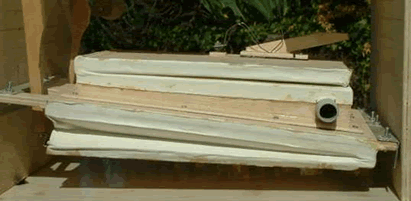
The reservoir output is connected, via a suitable pipe to the pressure box which will be described later on.
Even if the manual suggests to utilize the "blind fabric" for the three bellows, which is easily available in U.K., here in Italy such a thing is not easy to source, therefore I decided to use sheep leather easily found from a traditional shop of organ materials.