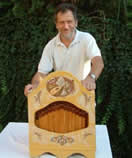
Our organ operation is based on the rotation movement generated by a crank handle actuated by the performer.
The crankshaft, connected to such a handle, moves a transmission system that activates both the compressed air generator and the traction of the music paper roll.
Let's see how the bellows operation takes place.
The crankshaft incorporates two u shaped rods, positioned 180° opposed which drive two con-rods whose job is to transform the rotating movement in linear movement, which they transfer to one side of the bellows.
The traction of the music roll system is shown in the photo.Three pulleys are employed and the smaller is coaxial to the crankshaft.
The latter transmit the movement to the central pulley which on his turn transmits it to the big pulley mounted on the spool shaft.
The peculiarity of the system is due to the central pulley, which is controlled by a clutch latch, which allows to take two positions: inserted in traction or idle.
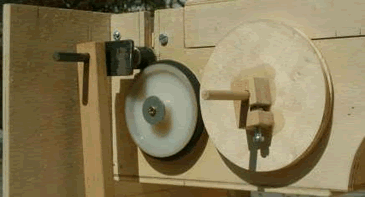
The choice of the two status is done by a mechanical lever on the top of the instrument and allows the rewind of the paper roll once the performance is finished,
Paper roll reader system and air distribution to the pipes
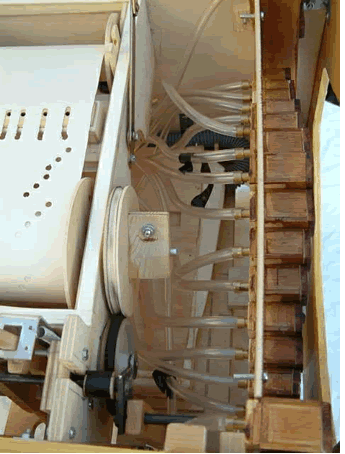
The Busker adopts a note reading system very simple and not conventional.
The punched paper roll is located internally to a pressurized box assembly (kept at constant pressure by the reservoir to which it is connected), and is towed towards the receiving spool passing on top of a "tracker bar" which allows the note reading. The tracker bar is a wooden bar put across the direction of paper transport, and has 20 holes which match perfectly with the holes on the paper roll.
In its bottom side the tracker bar connects the 20 holes with the corresponding 20 pipes through little plastic clear tubes.
The operation is simple: during the traction, untiIl there are no holes in the paper on the tracker bar the pipes are mute.